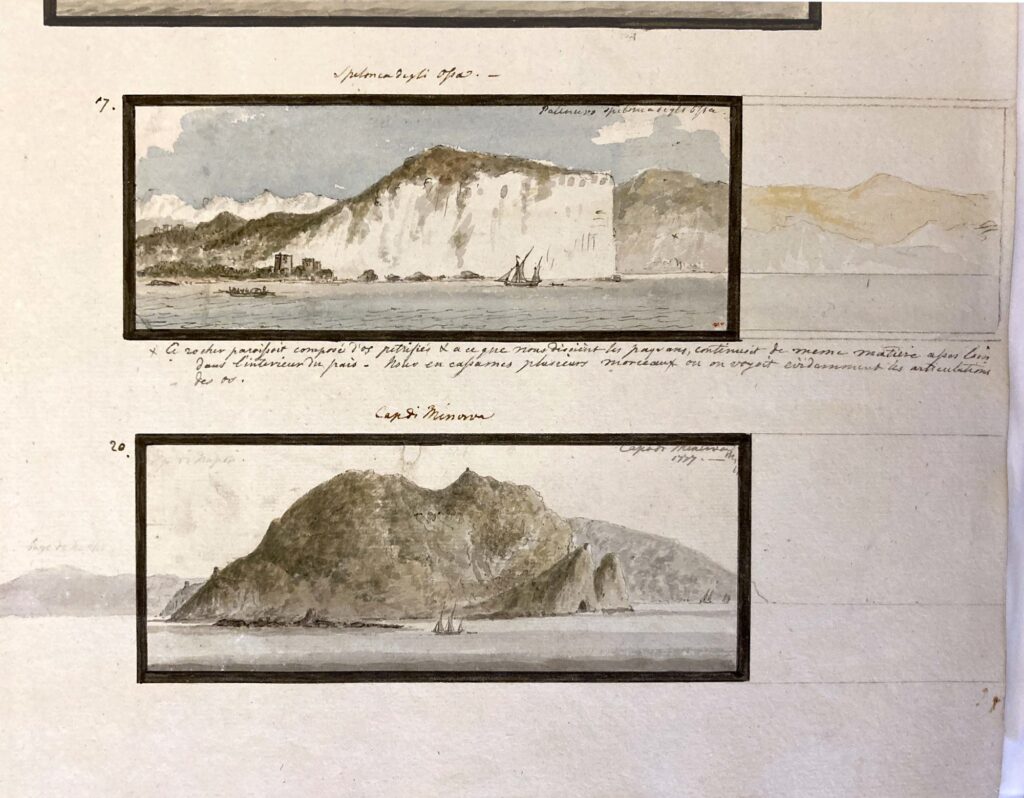
As images that cannot be clearly classified as either art or science, topographical views challenge art history. For example, coastal views created for nautical, military, or general geographical purposes were long ignored by researchers, or only ‘artistically sophisticated’ works, such as those by William Hodges, received attention. Using a specific collection, this PhD project traces the shifts in discourse and the history of collecting surrounding such images: the drawing volumes of Charles Gore (1729–1807), who produced over 1,500 watercolors while traveling along the coasts and rivers of Europe, often with the aid of a camera obscura. Gore mounted most of the works in six partly lavishly designed volumes, which are now in the possession of the Klassik Stiftung Weimar. While Gore's volumes have been interpreted by researchers primarily as the memory albums of a well-traveled amateur painter, my project outlines them as an encyclopedic atlas of European coasts, thus situating them within early modern scientific culture. Gore maintained contacts with the British Navy, worked as a ship designer and sailor, and conducted experiments to investigate the effects of ship design, wind, and currents on sailing characteristics. At the same time, he was closely associated with prominent landscape artists, art collectors, and art theorists. This case study highlights the tension between art and technical-exploratory knowledge practices around 1800. Gore's collection documents the media upheavals of a time when science, art, and the entertainment industry were increasingly drifting apart.